LispWorks IDE
The LispWorks IDE provides a smooth and comfortable workflow,
allowing you to incrementally write, test, and extend your software
while it is running. It is included in LispWorks
on all supported platforms. The LispWorks IDE is written using
the CAPI portable GUI toolkit and therefore
it runs natively on macOS, Windows®, GTK+ and Motif®.
Debugger
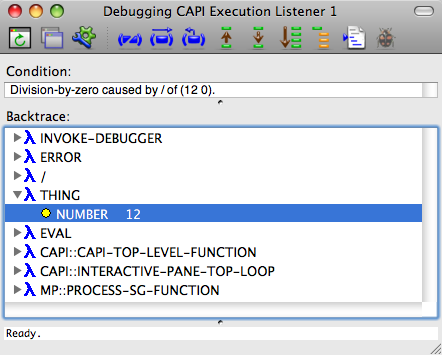
The Debugger tool offers an intuitive graphical view of the stack,
allows modification of variables and offers all the restarts. You can
jump directly from a stack frame to point reached within the function's
definition in an Editor tool displaying the source
code.
 |
|
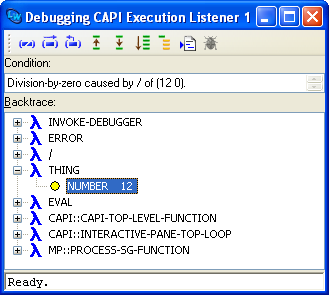 | Click image to enlarge. | | The Debugger tool on Windows. |
|
| |
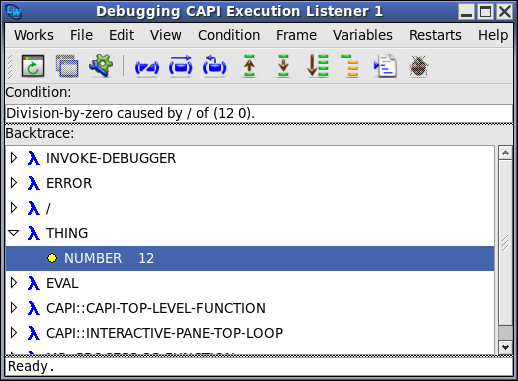 | Click image to enlarge. | | The Debugger tool on GTK+. |
|
| The Debugger tool on macOS. | | |
Listener
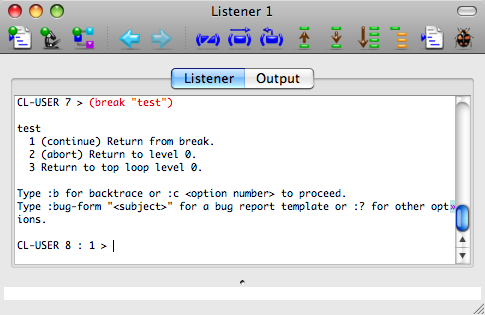
The Listener tool allows you to interact with the Lisp interpreter.
You can easily transfer Lisp objects to other tools such as the Inspector, or invoke the graphical Debugger tool .
 |
|
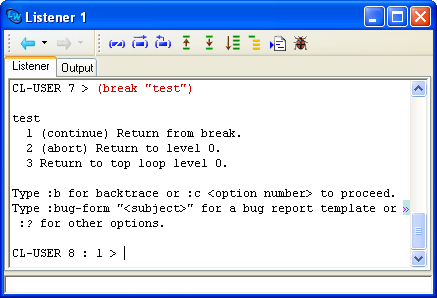 | Click image to enlarge. | | The Listener tool on Windows. |
|
| |
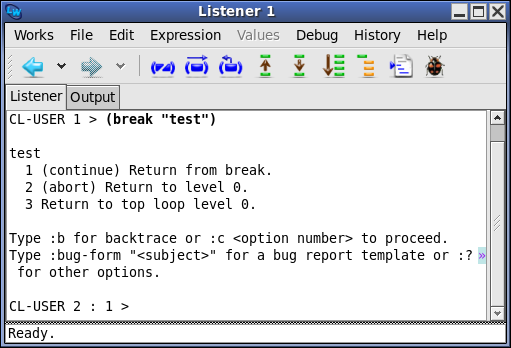 | Click image to enlarge. | | The Listener tool on GTK+. |
|
| The Listener tool on macOS. | | |
Editor
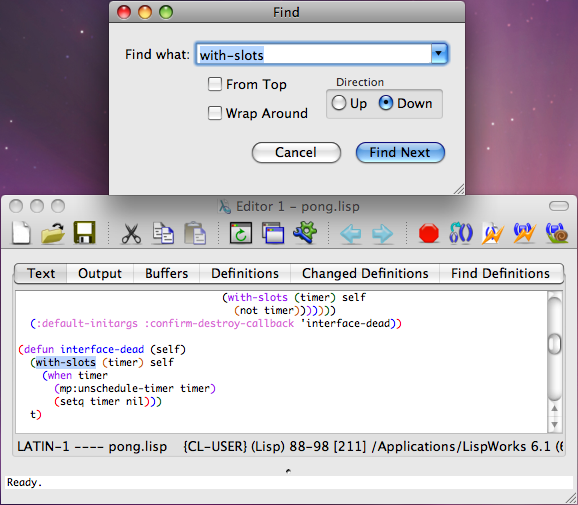
This is a powerful Lisp-aware code editor with built-in source location and syntax coloring. Commonly-used commands are accessible by menus and a wide range of commands is accessible either by Emacs keys or familiar platform-standard keys, all of which are customizable.
 |
|
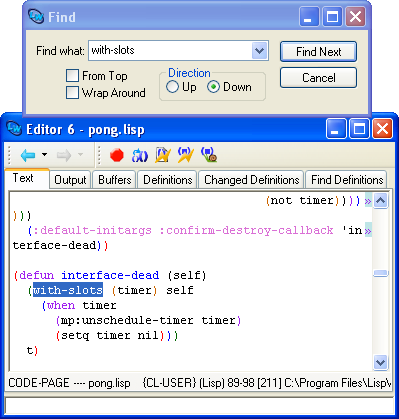 | Click image to enlarge. | | The Editor tool text view on Windows. |
|
| |
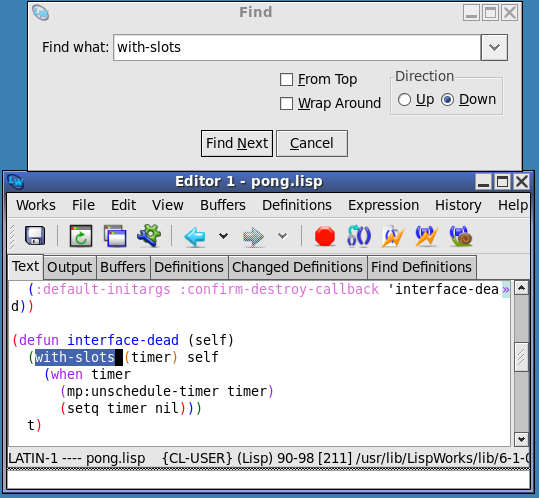 | Click image to enlarge. | | The Editor tool text view on GTK+. |
|
| The Editor tool text view on macOS. Click image to enlarge. | | |
Inspector
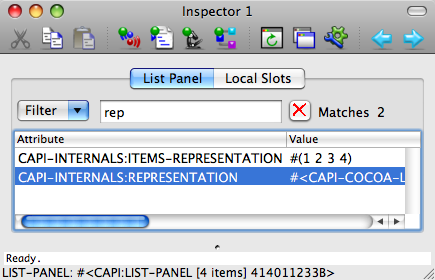
The Inspector tool is a graphical interface for the Common Lisp function
inspect. It is used for speedy exploration of Lisp objects
- just double click on a slot to inspect the value in the slot - and
can also modify the values. Further, the Inspector can be configured
with new views on your own data structures.
 |
|
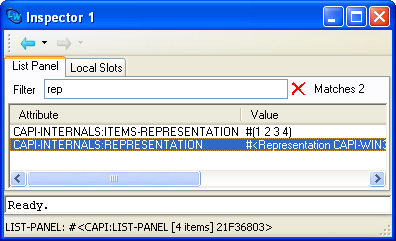 | Click image to enlarge. | | The Inspector tool on Windows. |
|
| |
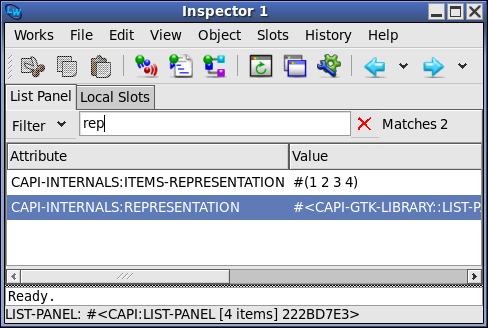 | Click image to enlarge. | | The Inspector tool on GTK+. |
|
| The Inspector tool on macOS. | | | |
The LispWorks IDE tools all work together smoothly. For example,
a frequent operation is to transfer the inspected object to the Listener
tool, achieved by the command Object
> Listen.
Other Features
Other features of the LispWorks IDE include:
- Stepper and tracer.
- Browsers for classes, generic functions, and compilation errors.
- Execution time profiler.
- Supports an external EMACS editor via SLIME.
- System tool supporting LispWorks
defsystem and ASDF.
- Incremental compiler and dynamic loader.
- Source code location and cross-referencing tool.
- On-line documentation in hypertext format.
